How to Use Multi-Theme Content to Reduce the Risk of Sharp Profit Fluctuations in a Single Tobacco Direction
At 9:40 AM on October 9, 2024, I refreshed the backend in a shared rental room in Yuhang, Hangzhou. The long video "Tobacco Flavor Structure Deconstruction" published the day before was still gaining views, but private domain inbound leads had almost completely stopped — not because no one was watching, but because the comment section had been flagged twice for "whether it constitutesrule-violating promotion." Within 24 hours, two related articles were restricted, and one of them saw its estimated readership drop from 12,000 to approximately 2,800 publicly visible.
What hurt more was the ledger. Confirmed income for the full month of September was 21,300 yuan, of which about 78% came from the same line:leaning toward "tasting/culture" paid notes and two small-scale tasting exchange sessions (compliance wording was very thorough, yet still highly dependent on the platform'sdiscretion regarding tobacco-related expression). In the first 9 days of October, the same line only confirmed 1,860 yuan. The oral care kit package and smoking cessation community were still slowly bringing in revenue, but the volume couldn'tcover rent and editing outsourcing.
What I wrote on my sticky note that day was not "make another hit," but a colder statement: A single direction is not professionalism; it's putting your cash flow on an audit switch.
Below is my real approach over nearly a year since then, using "related diversification" multi-theme content for profit hedging. This is not about encouraging you to turn your account into a hodgepodge, but about discussing: In the tobacco-relatedsector, how to use themes that are related to each other but whose revenue rhythms and risk sources are not fully synchronized to compress fluctuations to a sleepable level.
---
I. Why "Focusing Only on One Tobacco Direction" Makes Profits Like a Roller Coaster
Many people attribute fluctuations to "not working hard enough" or "the algorithm not giving traffic." I reviewed my confirmed income over 11 months from November 2023 to September 2024. The largest month-over-month decline appeared in March 2024 (approximately -41% relative to February), and the largest increase in July 2024 (approximately +63% relative to June). Effort levels were similar; the fluctuations came from structure.
1.1 Policy and Platform Advertising Red Lines: Inherently Narrow Revenue Pipelines
China has tightened internet sales and online advertising for e-cigarettes since 2019, with subsequentregulatory continuously strengthened; mainstream platforms impose extremely strict restrictions on advertising and promotion related to tobacco, nicotine, and relatedproducts. Even approved smoking cessation product promotions have age and compliance constraints. For content creators, the direct result is:
Half of profit fluctuation is often not about content quality, but about compliance bandwidth suddenly narrowing.
1.2 Hit Content Is Not Replicable + Long Decision Cycles
Tobacco health/smoking cessation users make decisions slowly: from "seeing a harmpopular science education" to "paying to join a community" can span 2–8 weeks. If you have a hit one week, the money may not arrive until next month; if you don't have a hit one week, your books look ugly immediately. With a single theme, you don't have a second "stable order" pipeline; you can only wait for the next breakout.
1.3 Seasonal and Node Misalignment
My rough data (2024):
If you only bet on one theme all year, you will spin your wheels during its off-season.
1.4 False Expertise: Turning "Vertical" into a "Single Point of Failure"
Vertical has value, but vertical does not mean leaving only one revenue nerve. In May 2024, my main account posted 5 updates a week, all the same type of "ingredient/process" hardcore content. The followerprofile was very clean, but advertising inquiries were almost zero (tobacco-relatedpromotion/placement is inherently difficult), and paid conversion was alsocrowded in a very small group. Verticality brought trust, but also brought a demand ceiling.
Personal view:
In thissector, the real danger is not "not being vertical enough," but understanding verticality as a single theme + single monetization path + single platform review preference. That's gambling, not professionalism.
---
II. What I Understand as "Related Diversification": Not a Matrix Illusion
In management theory, related diversification refers to entering businesses related to existing capabilities, users, and assets. Applied to content business, I use four tests for "relatedness":
If these four conditions are not met, it's called unrelated diversification — like suddenly doing beauty reviews or game commentary. That might scatter platform risk, but it would scatter your professional credibility, which is almost suicide for a small team.
In the industry, discussions about "content matrix" often emphasize multiple accounts and multiple platforms to disperse rules and review impact. This direction is correct, but many people execute it as: copy the samecopy across 10 accounts, with the theme still single. More accounts ≠ diverse themes; more themes ≠ real risk hedging. The key to hedging is: the sensitivity of revenue sources to commonimpact factors must be staggered.
---
III. The Multi-Theme Portfolio I Actually Use (and Why I Chose Them)
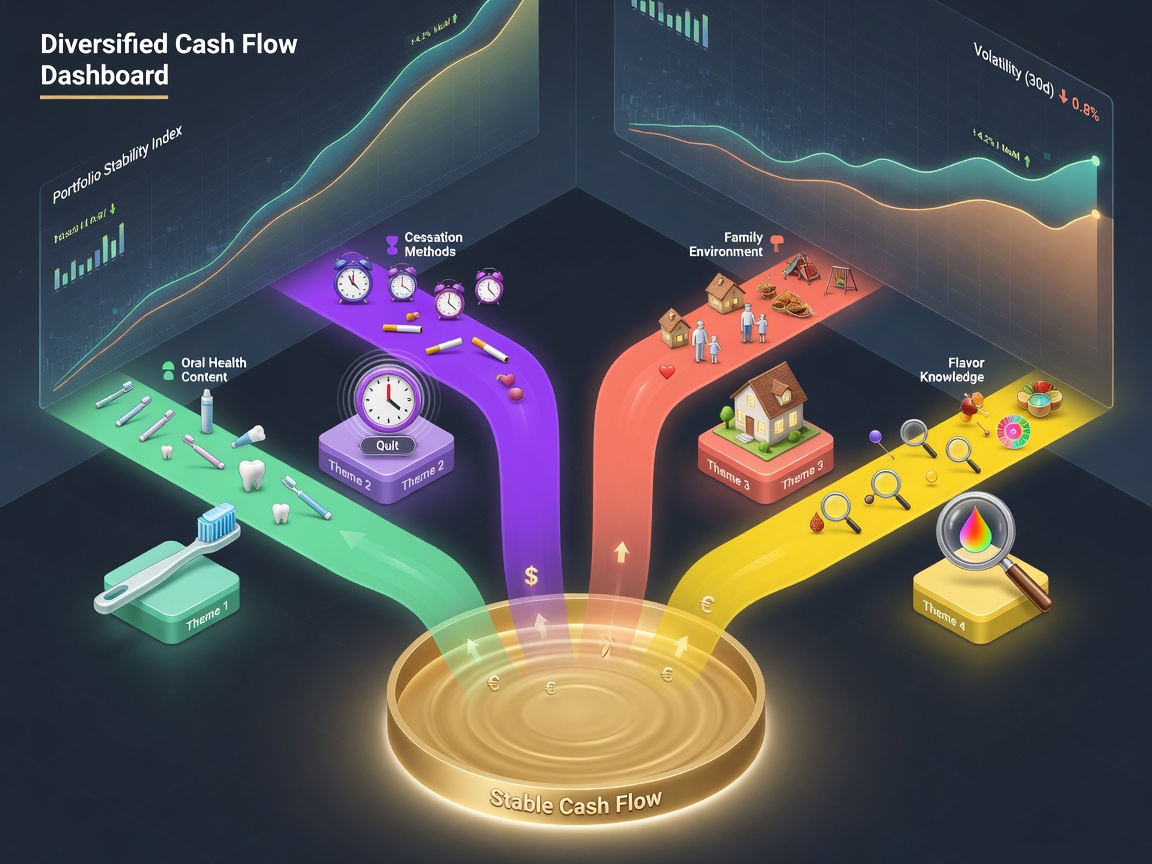
Starting in October 2024, I consolidated my content assets into four lines (virtualsplit within the main account, some users later directed to a sub-account):
Allocation Principle (written on my wall):
In Q1 2025 (January–March), I ran this allocation: monthly income fell roughly in the range of 14,000–26,000 yuan, and there was never again a situation like March 2024 where "the whole month relied on one line to survive." Not that I became richer, but the worst months were not asmiserable.
---
IV. The Real Pros and Cons of Related Diversification (With My Position)
4.1 Pros: Three Things I Actually Gained
(1) Fluctuation Smoothing, Not a Fantasy
In November 2024, Line B's gross profit nearly halved due to a high refund rate in the community (the assistantcommunication script was too aggressive,sense of commitment too strong); but Line A sold about 190 data packages, and Line C caught a small wave with two articles on "how to talk about smoke smell with family before the New Year." The total monthly income still stood around 17,000 yuan. If I had only been doing Line B, that month would have made mequestioning life.
(2) Asset Reuse Lowers Marginal Cost
The same research notes on "nicotine stimulation of oral mucosa" were written as self-check signals in A, withdrawal period taste change expectations in B, and secondhand smoke family communicationcommunication script in C. In February 2025, I calculated: onefoundational research note wasextracted into into an average of 2.4 publishable pieces of content, saving about 35% research time compared to the first half of 2024 when every article was written from scratch.
(3) Resistance to Single-Point Review Failure
When a platform tightened rules on "tobacco process details," oral and family content could still be published. In the matrix thinking, the phrase "dispersing risk" becomes tangible here: It's not multiple accounts saving you, but multiple themes giving you legally expressible space.
4.2 Cons: Four Costs I Paid Tuition For
(1) Energy Dilution Is Real
In November 2024, I once opened 5 themes simultaneously (added a "exercise as smokingsubstitute"), and the weeklyupdate pressure jumped from 5 to 9 pieces. Result: overall completion rate declined, Line B community response time dropped from an average of 6 hours to 18 hours, with 3 negative reviews that month and about 2,400 yuan in refunds.
The ceiling of diversification is determined by your delivery quality, not by yourtopic selection desire.
(2) Brand Perception Blurs
An old readerprivate message: "Are you about quitting or about reviewing cigarettes?" That sentence is worth 10,000 yuan — because it shows the trust model is cracked. My solution was tofirmly set the main account persona as "tobacco-related health and decision-making assistance," reduce the frequency of Line D, and clearly label it "cultural knowledge, not a consumption recommendation." The cost of blurring brand perception is far greater than posting two fewer articles.
(3) Public Costs Rise
After multi-theme, editing, covers, tables, and tag systems all became more complex. In January 2025, I fixed public tool subscriptions + part-time editing at about 1,100 yuan/month; if themes aresplit further, people can't keep up, and hedging becomes "using management costs toexchange emotional comfort."
(4) False Hedging: Highly Correlated Pseudo-Diversification
The mosthidden trap: theme names are different, but risk sources are the same. For example, "cigar process," "cigarette additives," "heated not burning ingredients" — three lines that look diverse, but when platform tobaccosensitive keywords are triggered, they might all die together.
Hedging depends on whether the impact factors are homologous, not on whether the titles are different.
4.3 My Position (Not Sitting on the Fence)
I support bounded related diversification and oppose two extremes:
Executable standard:
No more than 3 satellite themes; any new theme gets a 6-week trial budget (time or money, pick one as the cap); at the end of the trial period, you must be able to answer: has it reduced monthly income volatility, or only increased update burden.
---
V. The Process: How I Switched from "Single Line" to "Portfolio"
5.1 Step 1: First, Tag Existing Content with "Impact Labels"
On October 12–13, 2024, I exported articles from the past 90 days and tagged each with three labels:
The result was striking: about 61% of articles were concentrated in the "review sensitive + slow conversion" quadrant. That is, I thought I was building a content matrix, but I was actually stacking the same type of risk.
5.2 Step 2: Set "Main Anchor + Satellites" Instead of Equal Effort
Rules:
Many people fail because "they want every theme to be the main business." A hedging portfolio must have a main anchor, otherwise you will be shallow in every direction.
5.3 Step 3: Separate Conversion Funnels, Otherwise You Can't Tell If Hedging Works
I made each line independent:
Without separate codes, you can only see "this month made money," but not "which line was supporting." Hedging is a financial action, not a feeling.
5.4 Step 4: Weekly Scheduling by "Risk Allocation" Not "Inspiration Allocation"
My weekly template (commonly used in first half of 2025):
Inspiration can change the topic, but cannot change the risk allocation — otherwise, when busy, you'll chase Line D traffic all week.
5.5 Step 5: Monthly Review of Three Tables
In February 2025, Line D had good readership, but its theme-level profit/loss was continuously negative. I cut 50% of its scheduling per the rules and returned the time to Line B delivery. That month, totalreadership dropped, but total profit improved.
The sign of successful hedging is not a more lively curve, but a more controllable worst-case scenario.
---
VI. Two Failure Cases (With Numbers)
Case 1: November 2024 "Five Themes in Parallel"
Case 2: March 2025 "False Hedging"
---
VII. How to Judge "Hedging Is Effective": The Simple Algorithm I Use
No need for complex statistical software. At the end of each month, I calculate four numbers:
\( \text{MAD} = \frac{1}{6}\sum |R_t - \bar{R}| \)
Goal: MAD as a proportion of average monthly income decreases (I went from about 28% to about 15%, and only then felt thecombination was meaningful).
Additionally, watch one operational metric: confirmed gross profit per unit of creation hour. If this number declines after diversification, you are using "busyness" todisguise "stability."
---
VIII. When Should You NOT Diversify
Situations where I would directlyadvise stopping:
Personal view:
Hedging is a risk management tool, not an entertainment tool. The tobacco-relatedsector is inherently narrow with high compliance costs. First, make one deliverable line "livable even in bad months," then talk about a second line. If the order is reversed, diversification will only accelerate bankruptcy.
---
IX. A Principle Checklist You Can Copy Directly
---
I still write in-depth tobacco-related content, but I no longer use it as my sole engine. What the October 2024 traffic restriction taught me is: In a space with constrained expression, multi-theme is not diluting professionalism, butsplit professionalism into multiple independently breathing cash flows. Related diversification has costs; false diversification is more expensive. What is truly cheap is being willing to monitor sub-theme profit/loss every month, rather than staring at the view count of a single hit video.
If your dual account still only has one "tobacco hardcore" nerve right now, you don't need to open five accounts tomorrow. Starting this month, first add one low-sensitivity satellite line that can generate small orders (oral self-check or family smoke-free environment is often the smoothest), separate the code for 30 days, and see if the worst week feels less panicked. When the panic decreases, hedging has begun to take effect.